The Republic of Memory (The Song of the Safina #1), by Mahmud El Sayed
The Book
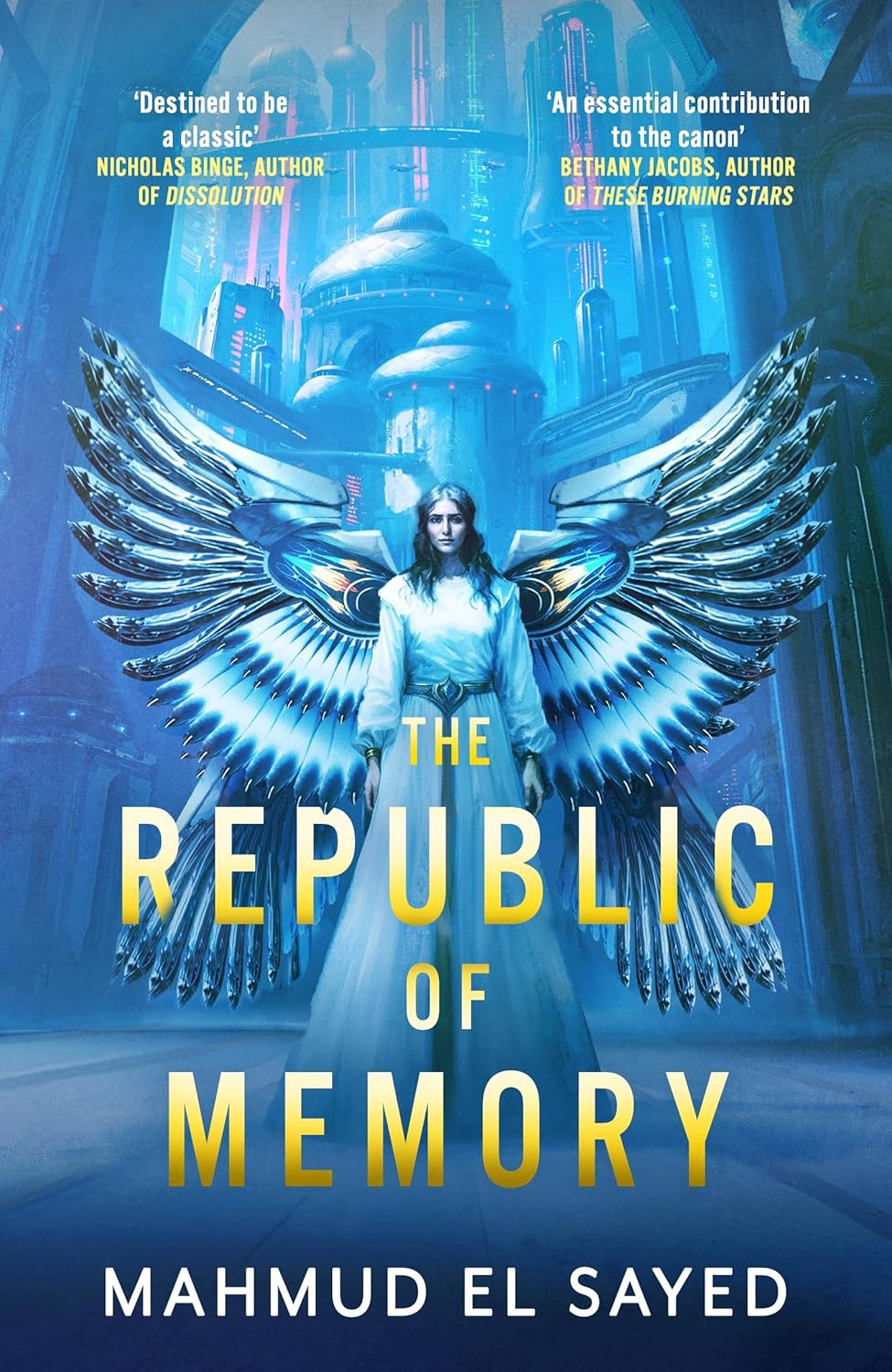
Synopsis:
The Safina is a city ship, two hundred years into its voyage from the ruins of Earth towards a new habitable world. Its crew maintain the ship, generation after generation, while protecting their 'ancestors' - the final remnants of Earth's doomed Network Empire - by keeping them alive in cryostasis.
But a lot can change in two hundred years, and people are starting to ask questions. Why should the crew continue to toil for people none of them remember? What exactly gives Administration its authority over everyone else?
And when the blackouts start, they set in motion a chain of events that will change life on the Safina forever. A reckoning is coming. The system is only secure so long as those in power maintain the obedience of those beneath them.
And the crew has had enough.
A science fiction odyssey of breathtaking scope, The Republic of Memory is a gripping examination of what divides us, and what brings us together. This is a modern and ambitious work of Arabfuturism, and is perfect for fans of The Expanse, A Memory Called Empire or Children of Time.
My Review
The Republic of Memory is the first book in the Arabfuturistic duology The Song of the Safina, written by Mahmud el Sayed and published by Gollancz. A refreshing space opera proposal taking place on the Safina, a generation ship, that at its core is a discussion about how future and societies can be shaped, inspired by the own events of the Arab Spring, and also discussing how languages and family can be elements that serve as a nexus between people in what is a choral story.
A story that takes us on board the Safina, where the crew is about to celebrate the annual Launch Day, which coincides with the midway point of their long voyage towards the new planet they are fleeing from Earth's destruction. A tradition that includes visiting the Ancestors, a chosen group of humans from Earth's Network Empire, preserved in cryostasis until the Landing Day, part of the original mission. But the situation is fastly deteriorating across the Safina, where blackouts and problems are becoming more frequent, tension against the Administration is rising as many resources are spent towards preserving the Ancestors; the final spark is a blackout affecting the stasis of many of those Ancestors, forcing some of them to be reanimated and integrated into the Safina's life, a spark that will mark the start a conflict across the ship. A complex and ramified story that will be told in the way of a choral play through many eyes across the Safina.
El Sayed kinda divided this story into two different parts: a first third where we are introduced to the people and the cultures that are part of the Safina, especially those coming from SWANA backgrounds, letting us get accustomed to how the things works while we learn about the problems that have become endemic of the city ship (and with much of the narrative weight focused on the character of Iskander, a translator, who also serves as a way to denote how the division by languages is one of the defining characteristics of this ship). From that point and on, marked also with the return to life of some Ancients and a big blackout incident, the narrative shifts to show how that's the final dropplet on the vase, how all the pieces that were quietly in the background start to move, a revolution from the people against an Administration that has become a caste, but also a movement that could be weaponized by other actors in their own benefit, in a parallel with the own Arab Spring movements.
The worldbuilding plays an important role in creating a cohesive scenario for the play, especially how the ship is divided by language, a concept that reminded me of the Teixcalaan duology; but also it helps to show the vastness of the own Safina population in contrast with those people we will be following across the story, a contrast that runs parallel to how that people can be the engine behind powerful changes.
The pacing is relatively slow at the start, creating a quasi cosy sensation at the start, but we can appreciate how it accelerates together with how the stakes are raised; it is true that the ambition of this novel might end up being confusing for the reader at the start, but just trust the process, as El Sayed excellently manages to pull all the threads together.
The Republic of Memory is a quite unique novel, a memorable story about politics and changes in a generational ship while including excellent ideas about languages, groups and belonging. A debut that only makes me more excited to read the second part of the duology!
The Author/s

Mahmud El Sayed
Mahmud El Sayed is a British-Egyptian SFF writer and translator. He lives in East London where he spends his time pondering linguistic oddities and running story ideas by his cat.
A former journalist, he covered ‘serious’ Middle Eastern politics until he had enough of chasing people up for boring quotes and decided to write about generation ships, sentient libraries and memory taxes instead. He won the prestigious 2023 Future Worlds prize for Fantasy and Science Fiction Writers of Colour and his work focuses on Arabic and Islamic-inspired themes in a genre he is calling Arabfuturism.