Some Thoughts with ... Mahmud El Sayed
The Author/s
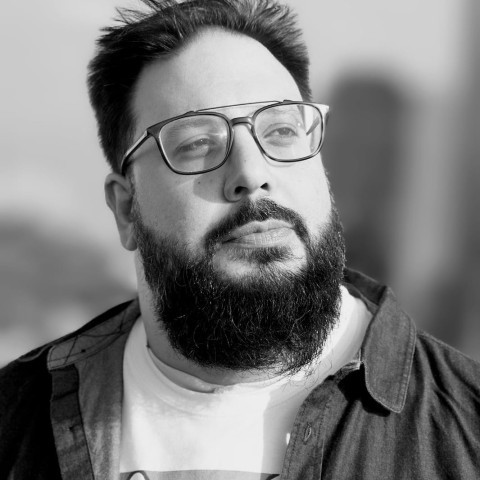
Mahmud El Sayed
Mahmud El Sayed is a British-Egyptian SFF writer and translator. He lives in East London where he spends his time pondering linguistic oddities and running story ideas by his cat.
A former journalist, he covered ‘serious’ Middle Eastern politics until he had enough of chasing people up for boring quotes and decided to write about generation ships, sentient libraries and memory taxes instead. He won the prestigious 2023 Future Worlds prize for Fantasy and Science Fiction Writers of Colour and his work focuses on Arabic and Islamic-inspired themes in a genre he is calling Arabfuturism.
The Interview
1.- Could you introduce yourself to Jamreads’ readers?
Hello, my name is Mahmud El Sayed. I’m the author of The Republic of Memory, an Arabfuturist novel which tells the story of a revolution on a generation ship inspired by the real-world events of the Arab Spring.
2.- When did you start writing fiction?
I started writing fiction in my teens and have written ever since. I’ve worked variously as a translator, a desk editor, a journalist, and most recently as a librarian, and I’ve always written fiction in the background. I suppose I first started writing “seriously” in 2020 when I took part in a Faber Academy Writing a Novel course in London which is where I first started writing The Republic of Memory.
3.- You define your work as Arabfuturism. How would you describe this concept? What characterizes an Arabfuturism piece?
I try to define this as broadly as possible. Arabfuturism brings together science fiction and technology with a distinctly Middle Eastern cultural aesthetic (so that includes language and religion, too). For me, Arabfuturism is about taking and claiming ground to allow us to tell our own stories set in the future. I think it’s vital that we imagine ourselves in the future and so writing this book was simultaneously an act of resistance and hope.
4.- In 2023, you won the Future Worlds Prize for Fantasy and Science Fiction Writers of Colour. How would you say this competition affected your career as a writer?
Yes, that was definitely the big turning point in my career so far. The FWP is such an amazing prize run by wonderful people. Previous winners include great writers like Esmie Jikemi-Pearson and MH Ayinde and I’m sure more people involved with the prize – whether as winners or shortlistees – will be getting published in the coming years.
For writers like me, perhaps the biggest stumbling block to being published is not publishing itself – which, let's be honest, is hard enough – but self-rejection. Representation is important because it lets us see that there is a space for writing like ours out there.
5.- Arab Spring is a big inspiration for The Republic of Memory; could you describe how it is reflected in your book?
Yes, the Arab Spring is a major inspiration. First, from a personal point of view, I did not get to experience Tahrir Square. I watched the revolution on television like most other people so writing this novel is kind of my way of turning back the clock. Second, there is a massive disconnect between the idea of the Arab Spring in the West and the Middle East. I am interested in the space between those two conceptions. The Arab Spring was not just that amazing moment of triumph, all those people in the Square on one fateful night. Life continued after the cameras stopped rolling and the western reporters returned home.
6.- How did it change this novel from its inception to the version we finally have as readers?
I’m a pantser (or to borrow George RR Martin’s term, a “gardener”) and so there is always a huge change in my writing between inception and final version. Actually, I originally envisioned The Republic of Memory as a kind of sci-fi Canterbury Tales, a collection of short stories connected by place and character. Fortunately, I ran into stumbling blocks during the writing process which forced me to pursue the multi-POV style and I think that has ended up working much better.
There are also major changes that occurred during the editorial process and my agent John Baker and my original commissioning editor Brendan Durkin made suggestions to help make the book what it is today, including even entire new chapters. The penultimate Badreddine chapter, for example, was one suggested by Brendan and I was initially wary about returning to that POV although I concede that it was necessary and made the story stronger.
7.- Something that took my attention is how varied the languages are across the Safina, and how each quarter/zone has developed its own slang. Could you tell us more about why you decided to give language such a prominent role in your novel?
Short answer: I’m a language nerd. My first “proper” job was as a translator for an Arabic-language newspaper and I remember that moment of realising that translation is more than saying x in one language means y in another but rather that these concepts go much deeper and do not always align perfectly. The first line of The Republic of Memory (discounting the prologue) is: When you speak a different language you become another person. I do think that is a truism. I’m interested in soft linguistic relativity, in the idea that the language we are speaking in and thinking in can, subtly, shape the tenor of those thoughts.
The novel includes Nupol, a conlang (an argot, really) made up of various languages. English grammar and syntax but vocabulary from French, Spanish, Portuguese, Cockney Rhyming Slang, Polari and even Nadsat – A Clockwork Orange. It’s the language of the rebels and the youth and I’m interested to see if I can get the reader on the rebels’ side by making them learn their language.
8.- The Republic of Memory feels like a big choral play, with a healthy amount of POVs. How did you manage to strike an equilibrium while simultaneously balancing as many different perspectives?
I think of it as polyphonic storytelling. It’s an understanding that I’m not telling any single character’s story or following any one plot-line. This is the story of an entire ship, an entire society. At the same time, it’s key to make rules for yourself as a writer and so The Republic of Memory follows a very simple A-B chapter structure, with A chapters being one of the two big POV characters and B being a secondary character so at least that way I knew what the next chapter or two would be. There’s an apt quote from E.L Doctorow that writing a book is like driving a car at night; you can only see as far as your headlights but you can make the whole trip that way. Well, I’m not a driver so for me writing a book is like playing a video game, one of those RPGS where you have to climb a tower to unlock the map. As you write the story and hit certain milestones, you realise where you have to go next.
9.- What can we expect from Mahmud El Sayud in the future?
Well, The Republic of Memory is billed as Book 1 of the Song of the Safina so I suppose that should tell you something? I’m also working on future books not related to the Safina including one set in a near-future post-Saudi Arabia involving artificial intelligences and djinn.