We Can't Escape the Rot - Sam Flynn
Rot carries a rank fascination. Entropy is one of the fundamental forces in the universe. Rot is the shadowy companion of death, preceding its occurrence and staying long after death leaves. Yet rot also ushers in new beginnings, new life, through transformation and renewal. Rot, like death, is natural – not that it makes it pleasant. The smells, the textures, the sights activates a warning system of aversion, fear and disgust in us. This universality makes rot excellent as a lingual and literary device, because it draws on a deeper, older human connection to the body, the earth and the universe. Even stars rot.
Rot doesn’t stop at the land of body though. Moral rot is just as terrifying, if not more so, because that rot is entirely within our hands. When I think of moral rot, I think of the antiheroes of Golden Age TV shows like The Sopranos, The Shield and Breaking Bad, as each demonstrates how all that is good and laudable in their main characters, meager though those qualities may be, is inevitably drained away by their criminal lifestyle, until all that is left is an amoral monster desperate to escape accountability till their dying breath.
Literature is much more suited to the more tactile and evocative forms of rot and few do this better than Jeff VanderMeer. More so than any other author I’ve read, VanderMeer’s work is, and I do not use this world lightly for the sake of my sister who hates it – moist. From his Ambergris trilogy populated by fungal, underground-dwelling aliens called the Gray Caps to his Southern Reach books where the coastal setting is actively decomposing and recomposing simultaneously, everything is covered in mold and surrounded by spores, the rot evoking not just strong reactions but thematic clues. In the second book Authority, “rotten honey” (a contradiction in terms because honey does not rot) becomes Chekov’s scent for the spread of Area X to the government agency supposedly tasked with containing it, a fact that slowly dawns on the reader while the main character toils away obliviously.
In A Song of Ice and Fire, death is ever-present from the first pages of the prologue until the prolonged rot overtakes the narrative in the fourth book A Feast for Crows and the fifth A Dance with Dragons, each focused on the aftermath of the series’ continent-spanning civil war.
A Feast for Crows in particular takes on an entire kingdom’s rot as its thematic purpose. Lord Doran Martell, immobile from gout, spends his days watching children in play in the water gardens of Dorne waiting for his decades-long plans to come to fruition, all the while the nearby peach trees shed over-ripened fruit that splatter red on the ground. The knight Brienne bears witness to the war-ravaged land on a pointless quest of honor, driving home how estranged the world and honor have become. New antagonist Euron Greyjoy outright compares himself to a crow espying death from afar. “And I say that all of Westeros is dying,” he concludes. “Those who follow me shall feast until the end of their days.”
Euron’s proclamation takes on a magical double meaning as the reader (and likely Euron himself) is aware that a horde of the undead led by the Others is on its way south to exterminate everything we would call life. And his promise to “feast until the end of their days” is a false one that always appeals the cynical, desperate and nihilistic because there is always an appeal in destruction for destruction’s sake, an appeal strongest for the impotent who cannot create.
This is the same reason there is a collective fascination with post-apocalyptic stories, particularly in the United States, where the wealthy ethos of “every man for himself” is at war with the necessities of the social contract. For individuals who feel unbound by such rules or have nothing to lose, the confines of civilization are oppressive and stifling and thus their only recourse is to abandon the rules, rules that either never served them or actively stood in their way. Examples include the elite fascination with doomsday bunkers and the longevity/”biohacker” movement. As author Tiernan Blanchard astutely pointed out on BlueSky the other day, this unquenchable thirst for unassailable safety from threats real and imagined is at the root of fascism. Moral rot spreads just like the natural kind, given the conditions for it to flourish.
I’d argue rot is also at the root of the 2026 fascination with cosmic horror (such the game and film Iron Lung) and liminal spaces (Backrooms), in terms of old traditions holding up so many institutions decomposing (sometimes literally) from the top-down, whether those old traditions are third spaces, democracy, or the notion of truth itself. Rot captures the feeling that everything is falling apart around us, to the point that many retreat more and more into isolated echo chambers. In Iron Lung, the main character is sequestered alone in a tiny submarine submerged in a blood ocean (subtlety, as Garth Marenghi taught us, is for cowards). When the main character in Backrooms discovers the titular hidden dimension, he is passing through a rotted hole in his reality to an uncanny world that offers comfort and caters to him, symbolizing his retreat into his trauma and echoing how people escape onto the internet.
The Rot with a capital-R is central to my new dark fantasy-horror novella Dweller in Darkness. The Rot is the in-universe name for an unnatural blight afflicting the lands of Yorgos, manifested as an ever-expanding field of glowing white stalks and growths called ghostgrass. To combat it, the people of Yorgos have adopted a rigid ritual of choosing seven young men called Lightbringers every equinox to descend underground and destroy the alleged source of the Rot – a malignant eldritch entity called “the Dweller in Darkness.” Only one of the seven ever returns, if at all but Yorgos plows ahead with its deadly tradition anyway as a means of social (and population) control.
Our main character Cassius is one of these Lightbringers, the last one in fact (no spoilers, this is spelled out in the first line). His story takes him underground to confront the Dweller and the Rot directly and what he discovers changes him inside and out, as you might imagine. Body horror is a rich and fertile tradition also receiving a notable boost in recent years, The Substance being my favorite recent example. My book definitely carries unmistakable inspiration provided by VanderMeer’s work, most notably the copious mushrooms found in Shriek: An Afterword (also an epistolary story like mine) and his first Southern Reach book Annihilation where the main character inhales alien spores that contain a “brightness” changing her from within.
In VanderMeer’s work, body horror and rot take on positive connotations with enlightenment and empathy. His characters aren’t corrupted by their infection or is it presented as wholly bad. The mushrooms growing over and through Duncan Shriek, the main character of Afterword, represent him opening himself more and more to the alien world of mushroom people stirring beneath his feet. The biologist main character in Annihilation begins the story already an alienated misanthrope, which makes her perfectly suited to adapt to the inhuman effects of Area X once she’s infected.
I drew on both classical and modern body horror to depict Cassius’ transformation. The Rot is no doubt horrific and the character experiences it as such but he is also freed psychologically and emotionally by the loss, as he is now attuned to the truth that he could ignore before his descent. In this way, body horror becomes a visceral vehicle for the theme, a device that takes the theoretical and makes it tactile. The horror gets inverted; as his body deteriorates, his enlightenment increases.
Unlike other art forms, books can capture all five senses, sometimes at once. Visuals are often a blunt instrument. Language, like music, is at its best a precision tool that nonetheless conjures something unique in the mind of every reader or listener. Images that might drive audiences to the exits at a cinema or gallery can have an allure on the page or in song. By their nature, the meaning of words are always changing, morphing, and becoming something new. The second law of thermodynamics states that in isolated systems (like our universe) entropy is either stable or increasing, never decreasing. Rot permeates everything. We should be grateful. After all, we’re already stardust.
About Sam Flynn
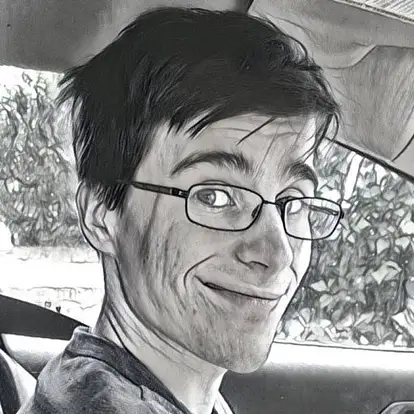
My story is simple, which is probably why I derive pleasure from inventing more interesting fictional ones. For those curious:
I was born and raised on the shores of Lake Erie, earned my B.S. in journalism from Ohio University in 2016, and worked as a reporter for local news and editor for an entertainment blog.
Through school and career changes, one thing didn’t: my passion for all things fantasy, horror & science fiction.
One of my clearest childhood memories is receiving Harry Potter and the Sorcerer’s Stone. I was seven and returned home from a camping trip with my father to find my mother had placed it on the pillow of my bed.
From there, the joy of reading dawned and still shines bright in me today. I went from YA series such as Artemis Fowl and A Series of Unfortunate Events to classics such as The Lord of the Rings and Jules Verne’s sci-fi tales and then Stephen King and A Song of Ice and Fire once I was teenager. Collectively, what might be called genre fiction. I had no clue. To young me, there were no such distinctions.
You develop reputations in life and you either fight them – or learn to embrace them. That I read more than most was the only thing people in grade school knew about me that I took pride in. Reading and what I was became one and the same. Then writing did too.
Long story short, here I am, editing The Darkest Fate, the first installment in the Vale of Tears series, a love letter to the epic fantasies I grew up on.
Stay updated on my work by subscribing to my author newsletter.